This post originally appeared on Murder Is Everywhere.
On the Friday morning in mid-October that I arrived from the USA into Nice, France, the airport wasn’t functioning. Perhaps a thousand people stood motionless yet clearly anxious in the airport’s immigration line ahead of us. I had arrived with a husband, a dog in a carrier, and ten pieces of baggage. It took a long time to get through the pack because—an airport worker told us—only 2 policemen were on duty.
The paucity of police at the airport could have had something to do with the emerging crisis anxiety for the Police aux Frontières (Border Police), the Gendarmerie, the Police Municipale (a highly trained urban force under the direction of Nice’s mayor) and the Police Nationale. The very next day was Saturday, October 17. Yes, the terrible day that people set fires in Paris, Limoges, Lyon, and broke into hundreds of shops. In all, an estimated 148 cities would be sites of manifestation, including tranquil and gorgeous Nice.
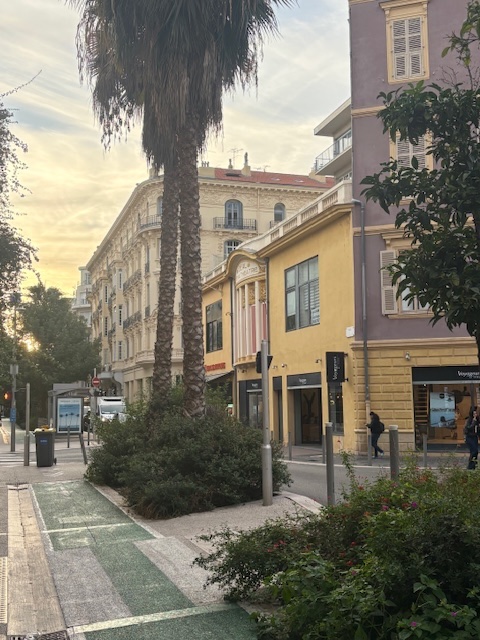
Tony and I knew about student protests when we headed to France, but didn’t know what was ahead for us in the city where we’d chosen to park ourselves for a few months. We woke up the morning of the 17th in the Carré d’Or, an upscale central neighborhood, excited for our first full day in the city. Friends mentioned there were some protests going on a half-mile from where we were, but we figured it would be like the peaceful Black Lives Matter or No Kings processions as we were used to in the United States. We hadn’t known that the bulk of Nice’s peaceful participants headed out by suppertime. It was when the sky darkened that people hiding themselves with masks and black clothing would take advantage of the situation and break shop windows and steal—at places on Nice’s central shopping street that ranged from cell phone retailers to Foot Locker and Calzedonia.
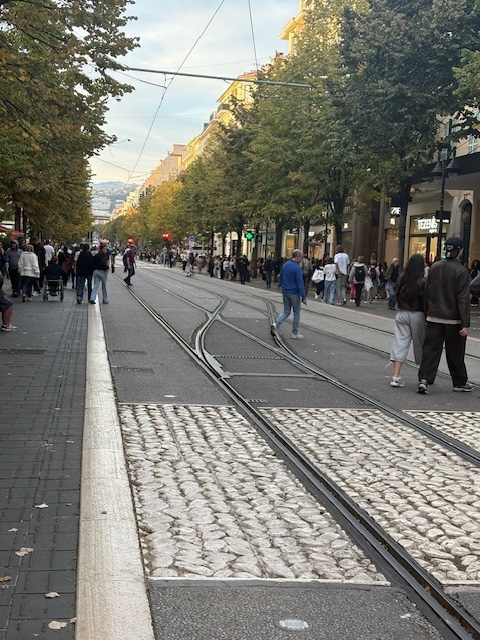
While hell was breaking loose, Tony and two friends and I with Daisy underfoot were just six blocks away, enjoying a sidewalk apéro followed by a Thai dinner. Afterward, as we walked our dog at 8:30 past the cozy restaurants and shops of rue Longchamp, we had been stunned to suddenly see a haze of tear gas and hear the bellowing sounds of a crowd getting louder by the second. In the dark it was hard to know what was going on—and we didn’t think the obvious “they are running from the police and the tear gas” but instead “they are running straight at us and we will have nowhere to hide.” What to do? Tony made an executive decision and started running back the way we’d come. We literally turned tail (our tiny dog Daisy was with us) and sprinted back to where it was quiet. And as we ran—others saw us running, and they too fled!
Later we learned that the police had taken full control of Avenue Jean Médecin, the central shopping avenue, by 10 o’clock, and no more than 16 shops had property damage. Nice had escaped so much—but naturally, the retailers and citizens were shaken.
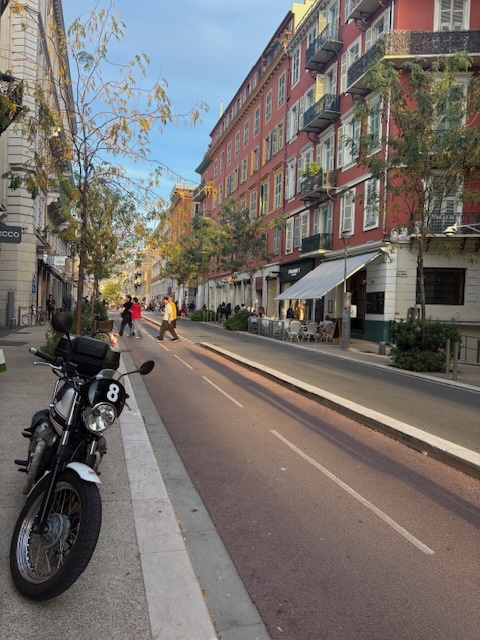
That was the first of our experiences of the Saturday protest events or “Manifestations,” as they are called in French; or people coming together intent on forcing the country’s government to act to improve their daily living conditions.
This particular protest movement started in September with students at one high school in the Paris suburbs demanding that the government provide funds to repair their school, and to intervene in the malfunctioning college choice system, among other issues. In my opinion, these are highly laudable goals. The challenge came when the movement spread to other schools, and some students became involved in property damage and assault—and police were charged with overreacting and hurting the students. The school movement got so much attention nationally that unions and others decided to hold a cost of living protest on October 17. They were also joined Anarchists and casseurs—the French term for protest vandals, who infiltrate demonstrations in order to engage in structural vandalism and theft.
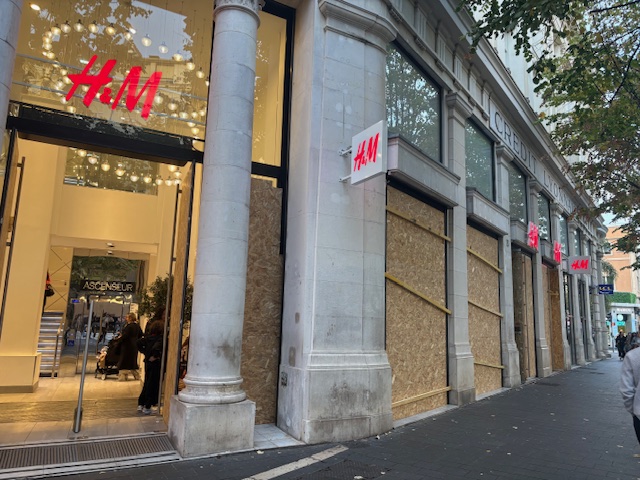
In the days after the tumult of October 17, Nice functioned as normal, with everyone going about to work, school, restaurants and shops. Giant boards covered the shattered storefronts of businesses like Foot Locker and Free Mobile; these were closed, but everywhere else, it was open. But after the media reported the protestors planned a new manifestation for Saturday October 24, shop workers began taking clothes of the racks and contractors preemptively boarded up their windows. Small batallions of private security guards in natty black suits massed in the most expensive zones, as well as the Border Police in camouflage carrying rifles. And all this activity was still happening, despite the proclamation of Éric Ciotti, Nice’s mayor, that no protests would be allowed.
Naively, I thought that a mayor forbidding a protest would mean there would be no protest on the 24th. I was underestimating the French, who believe so strongly in civil rights.
According to the City of Nice, on October 24th, 2500 showed up in the center of the city. This time, there was no property damage—perhaps due to a police presence of over 600. Although the protest was largely peaceful, there were situations where right wing agitators came in and attacked the left wing protestors. Tear gas was released and water cannons were fired to break up the melees.
On that particular Saturday afternoon, as I walked along rue de la Liberté, I noticed scores of police proceeding in formation toward me. I got home and went to bed. Close to midnight, I heard shouting and singing—and realized that Liberté had been chosen as an exit route for the demonstrators. The noise didn’t last very long, and I resettled into sleep. I awoke the next morning to see the shops still boarded up, but life going on as usual; people drinking coffee in the cafes, running along the waterfront, strolling children along.
I’m not worried about my safety while I’m here. I do worry for anyone who might get hit by tear gas, and the shop workers and the business owners. It’s not normal for a business to have to keep its windows covered in plywood and doors locked; to lose sales, Saturday after Saturday.
Guess what? There is a protest planned or tomorrow. The Yellow Vests organizers say it’s a statement against over-policing, and are calling it “Act III Halloween.” I’m sorry—but this name sounds pretty ominous to someone who’s tried to avoid horror movies all her life. Apparently, the national advice is for participants are instructed to come heavily disguised (as befits Halloween night) and masks. Mayor Ciotti has authorized a protest from 2 to 5 under police supervision. The official route will steer clear of Avenue Jean Médecin.
It’s startling to witness how street activism can change a sophisticated, thriving small city’s operation for three weeks running. And even more stunning to me is how it can be one day of disorder is rebounded by six days of normality. The show is going on. Would the French say, c’est la vie?