
This post originally appeared on Murder Is Everywhere.
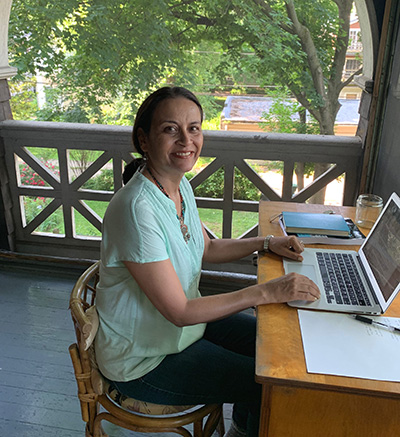
Not only am I an old writer, I started writing fiction a very long time ago. Seventh grade, to be exact.
It was the greenest of seasons—when I’d read hundreds of books but not taken a single class in the craft—was an afterschool pleasure coming after or sometimes right between homework assignments. Writing was a secret from my family: a private escape and not a job, like the part-time employment I had at Donaldsons department store in St. Paul. I was terrified at the prospect of anyone reading my deeply personal work.
When there are no expectations of having your work reviewed, the words flow fast. I found myself drafting a novel without an obvious end (except maybe the unpopular girl getting the high-status guy), and I had no illusions that it matched up to the quality fiction on the library bookshelves. Maybe the book would have gone on forever, but somewhere around the 500-page mark, my younger sisters found it hiding under my bed. They read it out loud in funny voices, cackling with cruel kiddy laughter.*
That humiliation made me feel it was too dangerous to expose myself through writing, at least while I lived at home. I even planned to study international relations, because I didn’t want to have to write. But as the college years continued, I realized that there were marvelous classes where you could read novels and write about them and then try your own hand at creative writing and get positively graded for work that had no research involved at all. While the assignment nature of writing was scary—as was the group criticism—there was also the possibility of being rewarded by someone who liked a turn of phrase or the characters. I wound up graduating with a degree in Writing Seminars at Johns Hopkins, though I did the responsible thing: get a job in journalism (which was enough of a coup to satisfy me). Working as a features reporter for five years turned out to be a great way to discover a city, enjoy a happy social life with newsroom friends, and get paid without fail every two weeks for writing mostly short articles. In these pieces, I could blend the assigned idea from my editor with my own voice. The Baltimore Evening Sun in the late ’80s into the early ’90s was a blessed place to be.
My desire to write any type of fiction was supplanted by the daily deadlines. Fiction went into hibernation until I was over 27, newly married and had left the paper. A two-year stay in Japan, where I taught part-time and studied Japanese and flower arranging, seemed like a very special season. And with a husband who was at sea with the navy half the time, I had time to spend as I pleased. I greatly missed him—but I also knew I had creative time that might never come again.
I began to write for pleasure once again. Over the next four years, I drafted a first novel, feeling sentimental as I did so, because I was preparing to tell the tale of how it was going into a drawer, hiding, just like that book in my teen years I hid from my sisters. This novel was created for my writing tastes and interest in the world, for me alone: a classic amateur sleuth mystery set in my fascinating new Japanese neighborhood, with a heroine who was so easy to write because she spoke exactly the way that I did. The work was harder, because now I was trying to write something “real.” I learned the business of the right number of sleuths, dropping clues, building tension and how to slow burn romance, bit by bit. There were such joyful moments when an idea came and made it relatively intact to the page—but there were hard moments of knowing I hadn’t said things right. Still, I really wanted to be there—to turn the trash into treasure.
The season of starting to write was my honeymoon. And then there was more than a year of revising—taking the advice of friends and fellow writers—and then finding an agent. Getting accepted by a publisher for a 2-book contract and having The Salaryman’s Wife debut with a wonderful cover, felt like a wedding (for me, the second one).
And then, what came next, seemed unbelievable. Lots of reviews, bookstores opening doors, an Agatha award for Best First Mystery of 1997. And that wasn’t the end of it. Book contracts continued to flow from HarperCollins, meaning I could keep bringing back my same circle of characters, and dive deeper in Tokyo, Yokohama and Kamakura, as well as select parts of the United States where Japanese culture was rich and my heroine could find adventure.
Although the situation looked great on the outside, I was often shaky on the inside. Now there were expectations I had of continuously writing books that weren’t only “readable” but growing in quality—at the pace of one every year. Invitations to contribute short stories to different anthologies came to me, and soon I was turning down most of them because I was fearful I’d not be able to finish the novel due that year.
In my mind, staying on pace with this publishing schedule meant that my writing became a calendar-scheduled, daily, 3-4 hour commitment. This may not seem like a lot to a non-writer, but trust me, it’s miserable to push your imagination that long. It felt like the kind of grueling schedule that a surgery nurse or a beat cop might work, although there was no boss managing the schedule. I was responsible for both cracking the whip and bowing to it.
There’s a hackneyed adjective that many people use for career writers: disciplined.
Disciplined is usually said to me as a compliment, but it’s turned out to be false friend. It reeks of regimentation and judgment. And certainly, I have lambasted myself for not producing a set count of words when I write; although I could within the first ten years of my career. It was different then. The hardest thing for me is getting started writing, especially because I do it in the morning when my mind is sharping. After the coffee’s finished and the dog’s walked, it means the time has come. Panic.
If first-publication season was springtime, the subsequent years, 1998-2006, were more like an autumn where the leaves took twice the time to slowly fade. At the end of this season, I learned that my longtime publisher didn’t want another Rei Shimura book. The readership hadn’t grown as much as needed. I mourned and entered a winter stage—where I cast about in my mind, and conversations with my agent, about what to do next. And what a coincidence: I was living in an icy-cold place, Minneapolis, Minnesota.
But there were so many good things about being in Minnesota, a bit removed from the energy of East Coast publishing, that made me feel safe to keep going with writing. I drafted another manuscript, this time sharing it with people in my trusted writing group of five local writing buddies, only one of whom had shared my New York publishing experience. No pressure anymore when I was writing, because there was no contract: and how those words skipped and jumped; and how much I enjoyed starting work each day. Springtime always came to Minnesota and also to my heart. I ultimately produced The Sleeping Dictionary, the most ambitious and beloved book of my career, which was published in 2013, a year after I’d returned with my family to Maryland.
For the last ten years, I’ve had the joy of writing a new mystery series for Soho Press. I don’t write as fast as I did in my twenties and thirties. The hardest thing for me remains getting started writing, especially because I do it in the morning, after that lovely cup of coffee. My mind is sharpest then—and I haven’t been distracted by a million things. But just having to start writing brings up the fear that it won’t go well. So, I resist.
Once again, I have someone expecting a book. And I have reviewers and booksellers and lovely readers who correspond, when is the next one? I read that last one in two days. I stop and start quite a bit now—sometimes laying the manuscript aside for a week before returning to it. I am more likely to revise the last chapter than start a new one—because oh, there are so many errors! I can’t let anyone down. At least once a week I wonder, if it’s this hard, does it mean I should be retiring? But if I retire, who am I anymore? How can I be not a writer?
I write this essay now in July 2026. Literally, it’s the heart of the summer season, complete with a humid heatwave. The book I’m working on is at the halfway point. A time that I always hesitate and feel stymied. I know the frustration always comes at this stage of a manuscript; but the problem of going forward always sends me off for weeks or months of worrying.
I can’t stuff off writing anxiety for good, but I have done a few things that are making the process go faster. I read a book on fast drafting, a process in which the writer must keep moving forward and has strict orders not revise until the whole draft is done. I think this book, Page One to Done, is good medicine.
Sisters in Crime, an organization that has been part of my life since my first manuscript, to which I belong, has a summer writing challenge going called “Summer Scrawl.” Every day in July, there are several disparate, dedicated hours available for member writers to write while a zoom session is on. It may sound strange, but what I’ve felt is the collective dedication of dozens of others writing at the same time, and the kind words of the host at the top of the hour, at the 25-minute break, and the goodbye. This co-writing has put me in the writing chair at 8 AM most of the days this month. Words began to flow like a drain slowly unclogging. I’ve pushed out ten thousand words in eight days.
I doubt that I’ll finish the last 40,000 words needed for my first draft in the final 22 days of July, but I feel that I’ll be happily quite close. And I know that the home stretch is the time I go gangbusters—when the work feels like play because the end is in sight.
* P.S. I forgave my wonderful sisters for their unauthorized transgressions against my teenage writing. In fact, within the pages of most of my books, you’ll see their names in print, along with my thanks.