This post originally appeared on Murder Is Everywhere.
I’ve been in Nice for 14 days, and as I pack my bags, I’m filled with yearning.
I’m not ready to leave.
Against all expectations, this city has won my heart. Even in a heatwave—one with breezes, tall green trees, and the sea nearby—I couldn’t get too bothered (and the temperature on the worst day was mid 90s, not the 104 recorded in multiple French cities). Walking past the art deco apartment houses and beaux arts palaces, I felt at times I was in South Bombay during the pleasant winter months. There was a mixed-up feeling in my body.
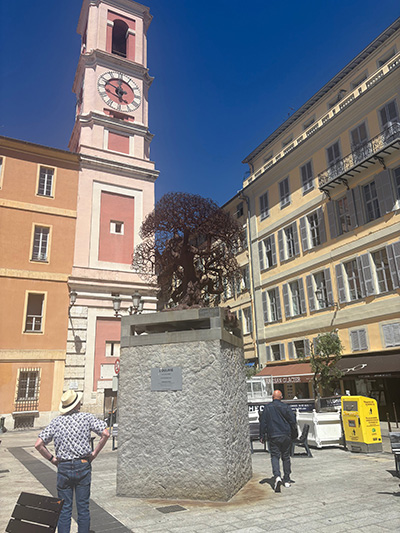
Ancient European migration patterns means Nice and the French Riviera towns around it have welcomed (or endured) travelers since pre-history. Greek and Roman inhabitation came early—and after that there were invasions from Barbarians, Saracens and Franks. Many Italian-French people call this place home. This part of Southern France bounced from being an independent kingdom ruled by a French line into becoming part of Italian-speaking Sardinia. Medieval Italian houses, Italian street and personal names and excellent pizza and pasta are always on the menu. Just across the Mediterranean are Tunisia and Algeria, former French protectorates, and as their status changed, both white colonials and people of color enriched the population of Nice.
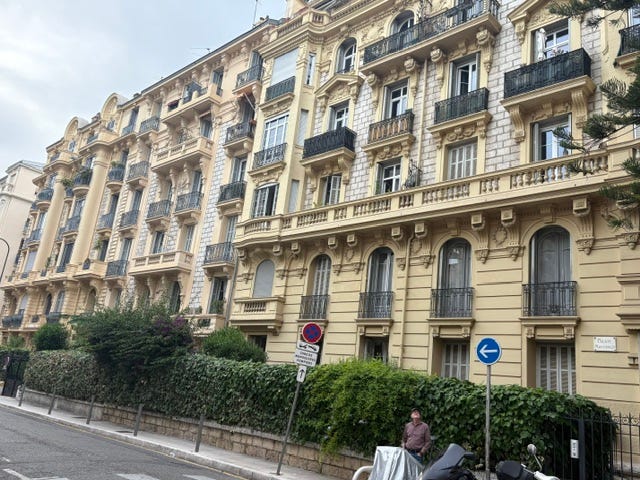
And hey, we can’t forget about the British. British travelers in the 1700s began writing rhapsodies about the location, drawing more of their friends to stay with them for sunny, warm winters. By 1860, when Nice had bounced back into French hands, a huge stream of wealthy British visitors had impacted its geography—financially aiding in building a waterside promenade that is still named after them as Promenade des Anglais. From the 1870s through the pre-world war I period—the Belle Epoque—Nice became a social nexus for captains of industry and their families, who traveled with servants and lived in gorgeous apartments for months at a time. Queen Victoria herself spent 3 springs in a row during the 1890s at the Excelsior Regina Palace, a massive Victorian hotel still standing but since the 1930s, occupied by apartment dwellers: among them, Henri Matisse, whose works are on display at a lovely museum nearby in the same hilly Cimiez neighborhood.
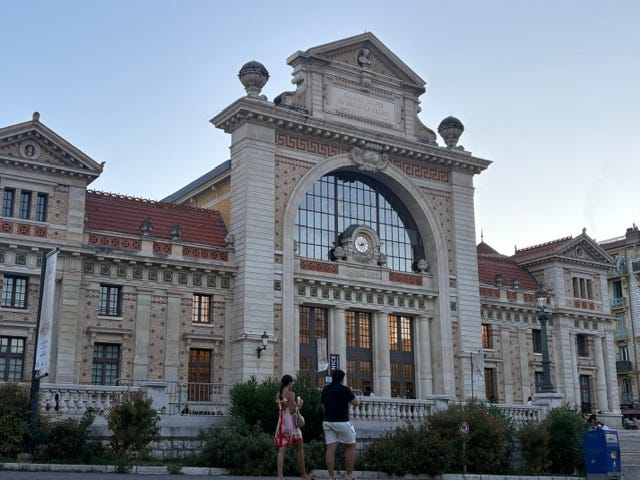
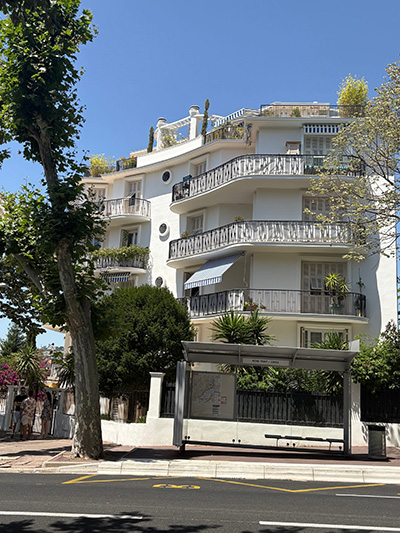
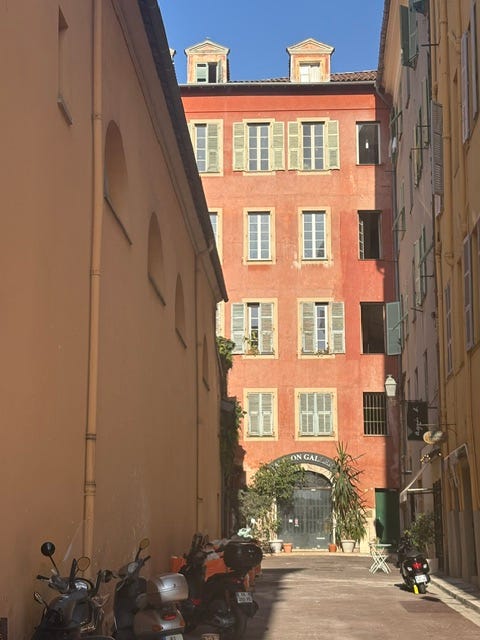
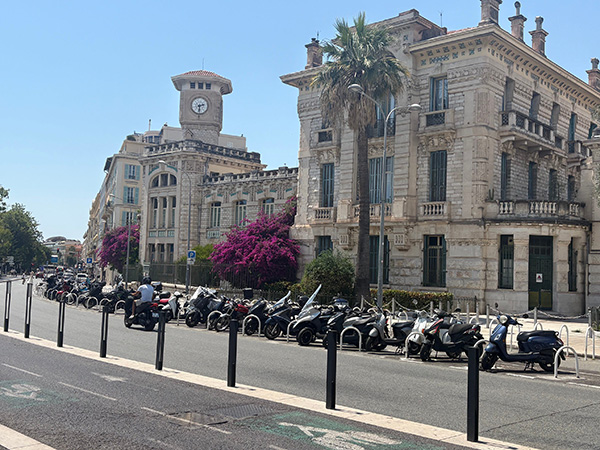
If you enjoy architecture, Nice is a paradise, from the grand belle epoque villas surrounded by lush gardens in Cimiez to the interesting medieval dwellings and proud classical Venetian apartment houses. Attached housing is common throughout the city, and I admired architectural flourishes ranging from art nouveau ribbons, flowers and leaves to art deco circles, diamonds and laurel. The old town near the water has much older houses, dating from medieval French period to the Italian 1700s; properties built tall and close together, and staircases leading through dark, cool paths and out toward the sunshine and water. Our Airbnb was in a very well-kept 1959 apartment building with a combination of art deco touches (like the balcony railings) and midcentury modern elegance in the simple, streamlined interior. The air conditioning was quiet and most welcome during the three hottest days of the trip.
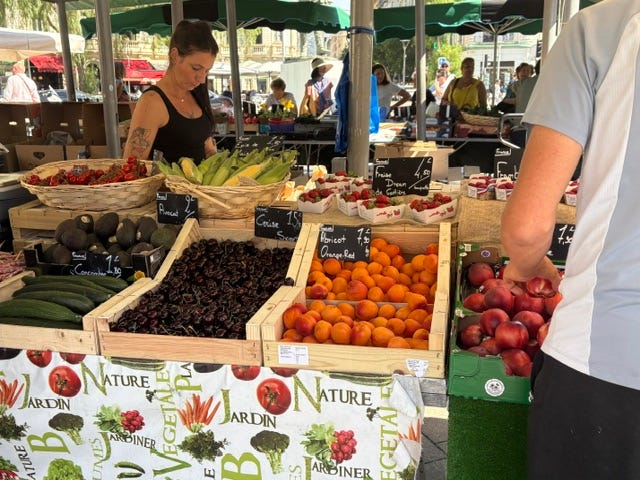
It’s mid-June, and the tourists are plentiful, though their numbers are slightly down as compared to usual. We heard this from Leticia, a co-owner with her husband of the fantastic Maison Joia restaurant, where we spent 3 hours on a fine meal; all vegetarian dishes made with local ingredients from small producers, served like art in six courses. The restaurant isn’t widely known yet, having changed locations from a touristy area into the quiet, yet creative neighborhood of Wilson Quartier (named in honor of Woodrow Wilson). This micro-neighborhood in the center of the city seems to have everything. Every day is a discovery, whether it’s walking by a shop selling pens, or collectible stamps, or cheese. We are staying on Boulevard Duboucharge, a leafy thoroughfare was traffic is busy at the rush hours, but the street has a tranquil feeling most of the day and certainly the night. Carabacel, which is more densely built up and has a good stock of interior design shops, grocery places, and casual restaurants. Alliance Française, the language learning school, sits squarely in Carabacel—close to Doma, where we tried delicious pizza and a magnificent salad on our first night in town.
Very quickly it seems I’ve adjusted to eating later in the evening, and it’s also nice to see that restaurants understand small appetites, especially in hot weather. Last Sunday was the summer solstice, June 21, which is a national French holiday called Fête du Musique, in which free outdoor concerts abound. We heard jazz coming from the central green lungs park. A fine mist of water sprang up from flat cement pavilions, where kids of all ages sprawled, enjoying the cooling and good tunes.
We didn’t only stay in Nice. My original plan, coming to the Cote D’Azur, was to visit many smaller cities, villages and towns that hug the coast. We’ve traveled by train to Menton and Villefranche-sur-Mer, and by bus to Vence and Tourrettes-sur-Loup, Monaco. The rolling mountains and shady trees and glorious bouganvillia are something to behold. Still, I find myself preferring the energy of Nice, and it’s easy to get around with electric buses and trams which even will take you to the airport.
How can a city stay old and true to itself, and also be so easy for modern life? And how is it that Nice and the Cote d’Azur towns had the lowest temperatures in all of France in the cursed heat wave?
Je ne sais pas, but I like it.