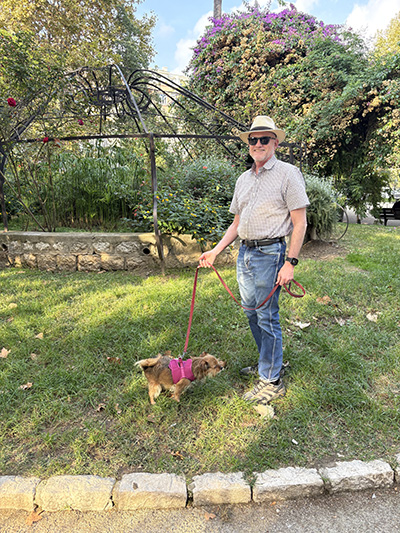
This post originally appeared on Murder Is Everywhere.
I was born with a kind of wanderlust that could keep me away from my home for months at a time. I’m sure many people are the same. We all dream, and obstacles block us. One of biggest barriers to being away for long periods is my dog. Originally there were two, and now there’s just Daisy.
Daisy is a little dog of unknown origins who stole my heart when she came into my home nine years ago. This has meant less travel, or travel alone with Tony staying behind to care for her, or both of us going and paying exorbitant dog care fees and also the cost of emotional withdrawal.
For all of these reasons and more, I decided the next long trip I’d take would be to a dog-friendly country. Tony was game to join me, especially since the two of we had a surprisingly wonderful time in France this past June, heat wave notwithstanding. When I was offered an opportunity for all of us, Daisy included, to stay in a new friends’ apartment in Nice while she was away for some months, I said yes immediately.
Here’s how it works in France, and as far as I know, the rest of the EU. A pet can avoid quarantine if you follow all the rules. For Daisy to travel on an airline from the USA into Europe, she needed a reservation, which depending on the airline is usually $200 or $300 for international travel. She also had to be carrying EU-specific documentation filled out by a USDA-certified veterinarian, plus have a valid USDA health certificate. She also was required to have a certificate showing a recent rabies shot from that special vet, and to have a certain kind of microchip (fortunately it had been between her shoulder blades for years). Depending on whether you were already a patient of the USDA vet, and what services you need, fees can add up quickly and the government certificate fee and Fedex charge are also high. And besides all this—there’s the reality of deciding if one’s dog can handle a flight. Our about-ten-year-old pet had never flown before—and she (or should I say we?) flunked crate training. But looking into Daisy’s warm brown eyes, I knew what she was saying. It’s the same request she makes anytime she sees Tony or me making to leave the house carrying a bag.
Take me.
I was insistent on taking her only on a direct flight to Nice—no changeover at Charles de Gaulle, which in my experience must be one of the hugest and most difficult airports in the world. During the off-season, not many airlines fly nonstop from the USA to Nice. But there is one airline that’s committed to a few flights a week between Newark and Nice. It’s called La Compagnie, and the have a small fleet of Airbus planes with just 76 seats, all of them outfitted as lie-flat business class. La Compagnie allows only 3 pets per flight. The pet need to be small enough that while inside a properly sized and ventilated carrier, the combined weight of both together would be less than 8 kg.
We decided in July to go to France—and the good thing was we would be traveling in mid-October. This gave us a window of time to get our long-stay traveler visas and also to prepare Daisy. Because Daisy had never flown before—and also because I fantasized about her gaining admittance to restaurants and shops in France—I knew she needed training. I called up our trusted dog trainer, Rachel, who has her own dog-training business called Positively in the Baltimore area. Rachel had briefly worked with Daisy when she first came into our home at 11 months. After Rachel had taught Baby Daisy how to relieve herself outside—instead of randomly, everywhere—we had stopped the training visits. I enjoyed the subsequent years with Daisy, who was happy in our home and a good friend to us and our visitors, but I’m embarrassed to admit we never stressed she comply with co,,ands like “sit” or “come” or “down.” Of course, she knows many other words: her family and friends’ names, and the all important “walk,” “din-din,” “let’s go in the car,” “potty,” “quiet,” etcetera.
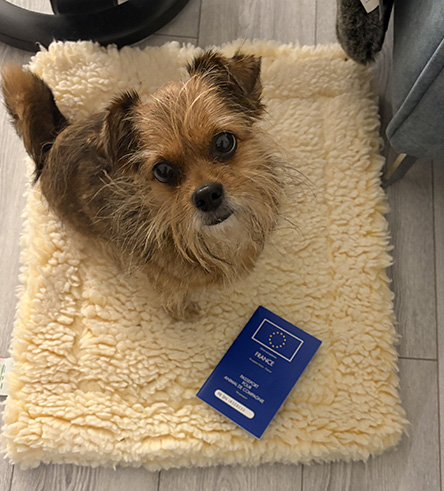
With the help of hand signals and soft mat (her ‘bed”), Daisy learned to ‘go to her bed’ ‘sit’ and ‘down—’ the reward being small chunks of a meaty treat. Rachel also recommended we get Daisy a textured ‘lick bowl’ and lightly coat it with peanut butter before placing it in the back of the carrier bag for her to casually investigate. No pressure! Thus, we slowly proceeded from letting her snack with the carrier’s entrance unzipped for several weeks, to having her snack with it closed up fully at intervals going up by five minutes every day. After she was able to calmly snack and lounge in the carrier the 2 hour mark, we felt more confident about the upcoming almost-eight hour flight.
The previously mentioned process for getting one’s paperwork to fly a dog is not especially tricky, but it involves not missing a step and also gambling on how long the USDA will take to deal with granting a certificate to fly. There’s a 10-day window for the paperwork to be accepted by the airline, and my vet’s assistant suggested timing the USDA paperwork in a framework that had typically worked well for other people traveling with dogs. We all forgot about Columbus Day Monday being a holiday—which meant Daisy’s papers arrived later than we thought: 24 hours before we were set to drive to Newark!
Boy, did I think we were smart to rent an SUV to ferry us the three hours from Baltimore to Newark. What I didn’t anticipate was that the rental car drop off at Newark International was located in an isolated part of the airport— from which the only way we could get to our specific terminal would be walking with all that luggage on two carts. Can you get ten pieces of baggage, plus a dog who was an airport novice, on two luggage carts?
Not exactly. But we were glad to have them to handle part of the load.
Tony rolled a suitcase with one hand and controlled the luggage cart with four additional pieces on it with the other, plus had a bag hanging off his shoulder. I wrangled a luggage cart with three pieces, Daisy’s carrier on my shoulder, and the dog on the leash. But the journey, which actually took us outdoors by a patch of garden, was a blessing of sorts—because Daisy decided to take a potty break here as opposed to anywhere else on the trip. She was in a subdued mood, having had a dose of Trazadone that morning—mellow, but quite able to walk. She’d had her last meal that morning—in the interest of keeping her from having to relieve herself later on. And we had no dog food with us—it was prohibited to bring it into France, anyway.
Daisy was allowed to proceed through the airport on a leash, and a surprising number of airport employees were kind about showing us where to go and giving us right of way into a particular compartment of the inter-terminal tram that was easier to get out of. A lot of people looked at us like we were crazy for having so much luggage and a dog. We said, “we’re not bringing this all back,” and I hope they realized we were talking about just clothes.
The airport checkin at La Compagnie was quick—all the desk attendant wanted to see was the paperwork, and he asked me to put Daisy on the scale, where she weighed in at a little over 4 kilograms, as I’d expected. Then it was a short stroll to the airline’s lounge, where I expected that I might have to confine Daisy to her carrier. But the young lady at the check-in desk squealed how cute she was.
Nobody told us to put her in the carrier. So . . .
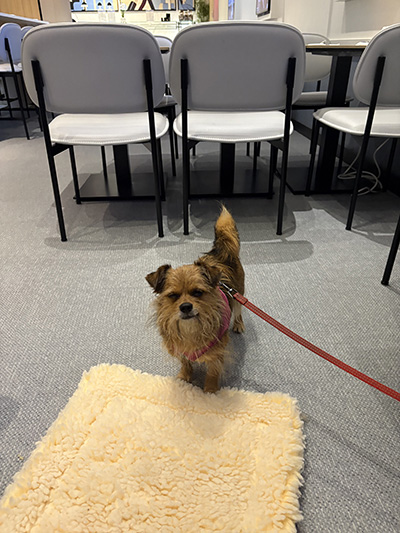
While in the lounge, Daisy stayed out of the carrier but on the leash, resting on her soft mat, for two hours, while we sipped and ate French hors d’ouvres in a room that almost entirely emptied out of people after the boarding time was called for La Compagnie’s Paris route. Not many people appeared to be going to Nice. Seeing how relaxed Daisy had been in the airport, I thought her training has paid off. We all would survive the flight.
When we boarded the 8 p.m. flight to Nice, there were only 15 other passengers on the plane. We had just three flight attendants, all of whom were dazzlingly attractive and kind. It was almost like a charter flight. All the unused seats meant that while Daisy slept peacefully in her crate by the window seat, with me on the lie-flat seat next to her. Tony moved into an empty seat on the other side of the aisle. The flight attendants didn’t mind us changing things up. One of them suggested it would be a good idea to take Daisy out of her carrier and hold her, for the hour before we landed, when she was beginning to get a little barky. Not company policy at all—but a special circumstance.
The whole trip was starting to feel very special. But the charm swiftly dissipated upon arrival. The Nice airport, usually a quick pass-through, had huge crowds of waiting people before the immigration checks. This was the only truly terrible time for Daisy, because we had zipped her back in her carrier, and we were now rolling the carrier on its wheelbase through the airport, something we hadn’t practiced at home and that must have been pretty scary. How she barked!
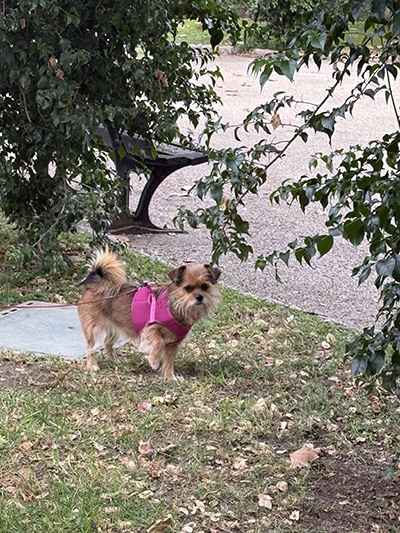
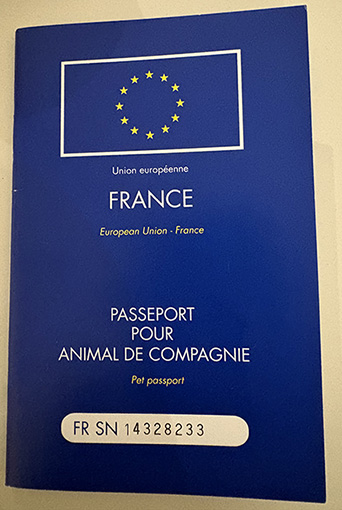
We were relieved to emerge after about an hour into the sunny outdoors. There had been no paperwork or inspection for Daisy at the airport, but in the days that followed, we brought her to a French vet, who examined her (suffering a nip when he tried to see her teeth). Still, he duly filed paperwork for an “EU Pet Passport” which we received days later and we understand will allow her right of entry in other EU countries by car. We may also use the passport later on as a credential to fly in and out of the EU from the US, as long as we made sure she had a rabies shot from a French vet added to the passport before our departure.
As I watch Daisy napping peacefully near me as I write, I have to give her credit for her strength through all the changes. Not just the time change and the different food—but life in a fourth-floor apartment in a large building that houses other dogs and has plenty of loud noises from the street. She was clearly fearful the first two weeks—especially if both of us left the apartment. So we shifted to try to keep her with us as much as we could, and that seemed to relax her. The weather is generally warm and sunny, and Nice is a truly well-developed Mediterranean city with a commitment to developing green space. The old streets are graced by tall trees and patches of green space like the lush plantings of shrubbery by the many bike lanes. Nice has historic pocket parks, and a large linear modern park: the Promenade du Paillon or the Coulée Vert. This green zone offers wide paths for walking and lush green lawn (even in November) for rolling. Dogs aren’t allowed on Nice’s urban beaches—but they are certainly allowed on the Promenade des Anglais and in the many bars and cafes that decorate the stretch like colorful costume jewels. Some of our happiest moments have been taking Daisy along for a restaurant or brasserie meal. She now mostly lies down by our feet, although it’s still hard for her not to resist a warning bark at servers threatening us with their trays of coffee and cake.
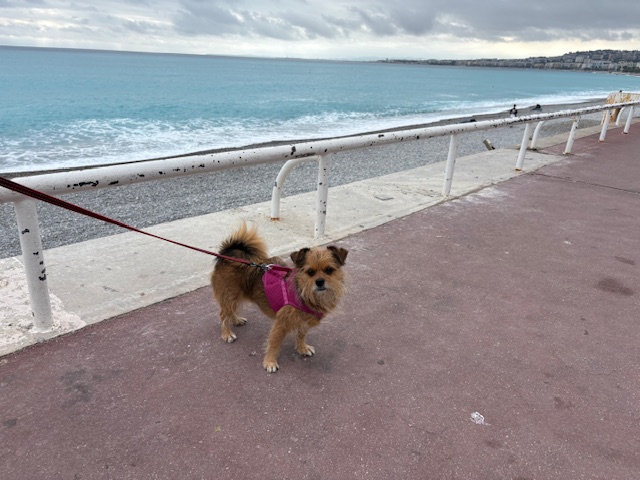
Nice is a city populated by tiny dogs, often with fabulous haircuts and cute accessories. While Daisy is almost toy size, she stands taller than at least a third of the dogs in Nice. It’s an interesting experience for her to be a medium-sized player in the area, and she seems to be walking a bit taller than before.
And this new kid in town has picked up a new passion: scent-trailing. Not for French perfumes, or even the nearby truffle shop: just sniffing everywhere. How many smells there are in the old streets of Nice, full of businesses and cafes? There’s still an overall abundance of aromas that must be as foreign to her as the utterances are of my French neighbors.
This past Wednesday morning, I left the apartment at eight-fifteen, walking 7 blocks to Flexx, a fitness club. There I spent a pleasant time exercising in the pool followed by a shower and dressing to go out. I didn’t pause for champagne at the gym’s bar (yes, they have it available, as well as all kinds of coffee and meals) but walked to Monoprix. I was two blocks away from the gym on a side street when I heard my name shouted aloud by Tony.
I turned to see Daisy rushing along on her leash, dragging her father along for the ride. As he put it: “When she got downstairs this morning, she must have smelled your path because she went crazy wanting to lead me in the direction of Avenue Jean Médecin. Then she insisted on crossing it, and she brought me to the gym. Then she got excited again and started pulling me this other way.”
Daisy is an unknown mix—she looks maybe like a Yorkshire terrier, Norfolk terrier or Belgian Griffon. But what about what we can’t see? Maybe she had an ancestor in the hound family. In Baltimore, she had demonstrated the ability to track her beloved mailman a block or two away—but that seems like kid stuff compared to her mom-finding mission through so many unknown French intersections.
Bon dieu! I am a dreamer, but I never dreamed that my undertrained canine could master such a complicated reconnaissance. But perhaps Daisy interprets her new France Passeport Pour Animal De Compagnie as offering her special powers. After all, if she can live and work here freely, why not take up the profession of détective?