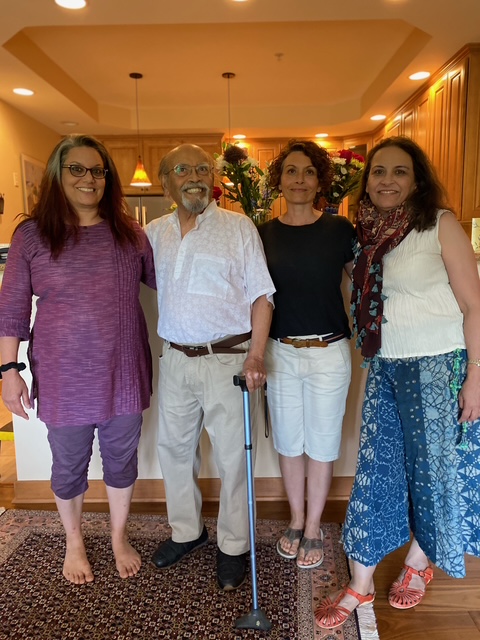
For the last two weeks, I’ve been working through the painful loss of my father, Subir Kumar Banerjee, who passed away at his home in Saint Paul, Minnesota on September 20. We are pictured above, five years ago; my sister Rekha is on his left, and Claire is just to his right.
On the outside, my life path looks very different than my father’s; but he stamped every bit of my development. He’s the one who championed my early poems and stories, embarrassing me no end. Yet I felt supported by that enthusiasm when I made the choice to go into newspaper journalism and then into mystery writing. An entirely precarious pair of careers, but he kindly never pointed that out.
It took years for him to share that he’d longed to be a literature major at Calcutta University, but was forced by parental wish into the sensible world of science. And while he only began writing creatively in his last decade of life, the career path he undertook in his twenties was filled with creativity and success. From a tumultuous childhood in India where he attended public schools, my dad emerged in the late 1950s prepared to study geophysics as a graduate student on full scholarship at Cambridge University. After that, he grew to become one of the world’s foremost geophysicists. To me, he was a quiet father who took the bus every morning to his office in Pillsbury Hall at the University of Minnesota. He came home in the evening and with gusto, narrated to my mom, my two sisters what delicacy he’d eaten for lunch at a restaurant near campus.
Subir Kumar Banerjee was born in the late 1930s in Jamshedpur, Bihar, a province at neighboring Bengal, his family’s ancestral base. A lot of Bengalis carry the surname Banerjee. The original name, before the British simplified it, was Bandopadhyay and means teacher. Lawyers and landowners and priests decorated my family’s father tree, on both the paternal and maternal sides. Yet he never said much about them until the last twenty years, when I trying to learn choice bits that he could recall about his life in British colonial India for my novel, The Sleeping Dictionary.
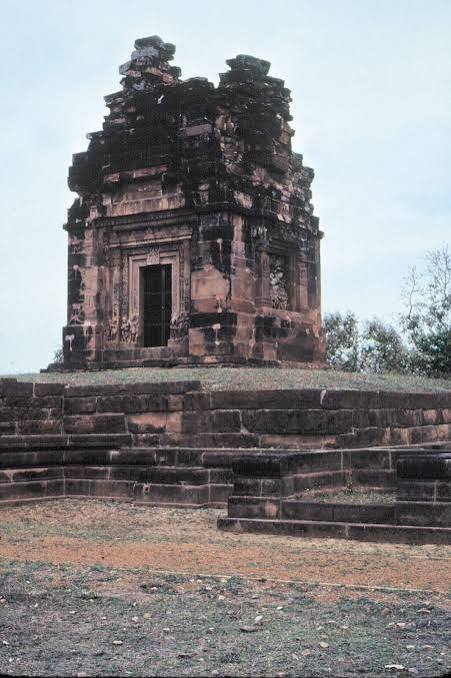
My father’s family had lost family wealth during my grandfather’s childhood. This meant that instead of going to university, his father Benoy was sent to a technical college where he was educated to become a licensed electrician. Subir was the eldest of six children, and in pursuit of work and a good environment, the family moved frequently. As a very young child, he stayed with his maternal grandmother for a few years in the Bihari village of Deoghar, pictured above, where he watched other boys undertaking their priests’ education at the town’s many temples. In fact, he wished to attend such a priestly school, taught only in the Bengali and Sanskrit languages, for himself. English seemed hard and scary. However, he was ultimately reunited with his parents in Jamshedpur and started a rigorous, conventional education at a public school. He was close friends with another classmate, Makhan, who was his chief competition. If Subir stood first in their grade, all was fine; but on the times that Makhan got that honor, my father received a beating. My father got through it, and he stayed close to Makhan although they were separated for decades after their undergraduate days in Calcutta.
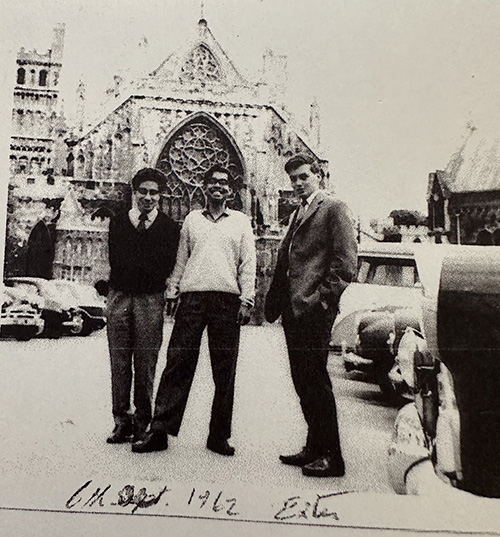
Hearing about Subir’s harsh punishment from his own dad was a shock to me. It also explained why my father seemed disinterested in my report cards during childhood. My grandfather believed fear would lead my father to study harder; but the fact was, his eldest son was thrilled by learning and achievement. Subir received bachelors and master’s degrees in India with honors, and he went to graduate school at Cambridge on a full scholarship awarded to him by Shell Oil. He’s in the center of the picture below with two of his best friends from student days in 1962.
My father had a joyful experience in Cambridge, where he wrote a thesis on the magnetic properties of rocks and minerals that was a precursor to his 50 years-plus of work in rock magnetism. He made lasting friendships there that later paved the way for his entry into university life in the United States. He also met and married my mother, a student who’d come from Germany to Cambridge in order to study translation. Subir was an active attender with Cambridge’s Meeting of the Society of Friends, and he was a delegate representing British Quakers at an international peace conference for youth in the USSR in the early 1960s.
Subir never converted from Hinduism to another faith. However, he abhorred the caste system and discarded his sacred thread, the symbol of Brahmin males, and took great interest in finding common values with other people coming from other faiths. He was a child during the horrific partition violence of 1946 and 1947, long periods of rioting and genocide during the movement of Muslims to the new nation of Pakistan, and Hindus in that now-Muslim territory fleeing to other parts of India. My father’s life was filled with friends who were Muslim, Bahai, Jewish and Buddhist. He read the poems of Rumi and the teaching of Buddha. He developed a strong interest in the history of science, especially bringing to light the contributions of centuries-old Asian scientists. Because of this, he studied Arabic, adding it to his existing repertoire of Bengali, Hindi, Urdu, Sanskrit and English.
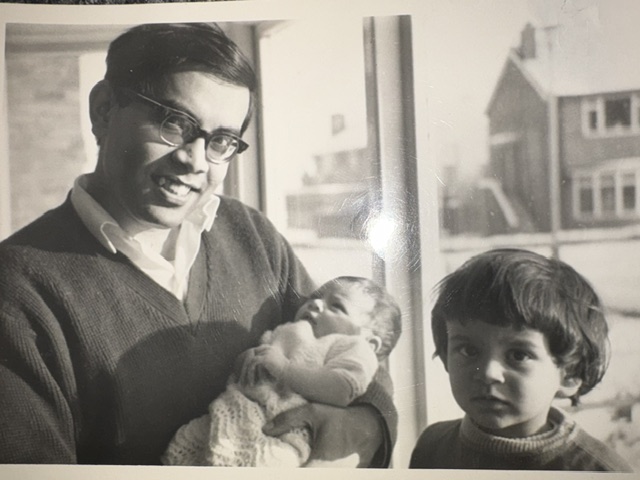
Growing up in an immigrant academic family in a midwestern suburb sometimes felt odd. It seemed as if everyone else’s parents worked at 3M or Control Data doing ordinary things. These Minnesota families dressed conservatively and partook of luxuries my father disliked: color TVs, multiple cars, and any form of casual spending on nonessentials: excepting for books, music and food. Our suburban Minnesota neighbors had power boats or canoes on their properties, always ready for a weekend trip to the cabin “up north.”
In hindsight, I realize that we Banerjees existed in our own cool subculture. My dad had a thick beard, wore Birkenstocks and jeans to work, and played folk music on the stereo. He gave me gifts like the poems of Anna Akhmatova and the music of Buffy Sainte-Marie. Almost all the adults who flowed through our house came from afar. My parents hosted what we girls called ‘standing up parties’ at our home—drinks parties and potlucks for graduate students and colleagues. My parents baked their own pita bread and made hummus before you could get it in the store. It was a roaring good time.
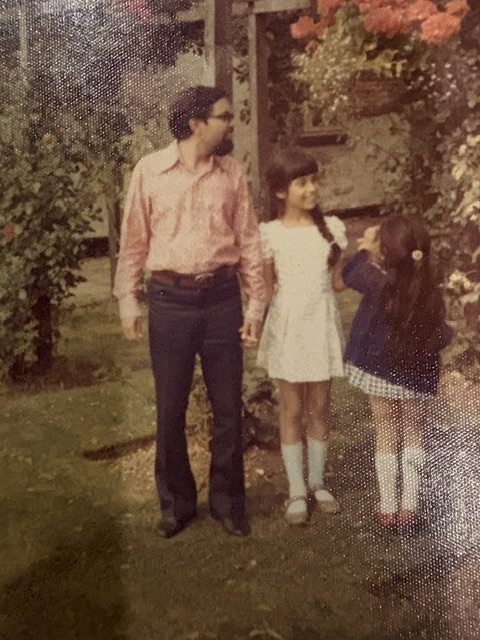
I also have fond memories from our late 1960s years in Philadelphia, when he was at the Franklin Institute of Science, studying rocks from the Apollo Mission—though to us they didn’t look like much. He wanted to show us the magic of nature. Sometimes we felt pulled in and took time to look at the glistening beetle, but often we were just loud kids running around in our world. My father’s work was stressful, and at some point, he developed depression—though nobody knew it, and I thought he was angry at the sound of kids being kids. There were times that he rested alone in his room with terrible headaches until he felt able to rejoin us. My happiest moments were when the aromas of garlic and onion wafted to my bedroom through the heating vents; and I knew my father was cooking an Indian feast. He’d become a passionate cook during his student days in England, and in the following decades, his recipes grew ever more intricate and delicious: perhaps an Indian pillau flavored with saffron and nuts, or a creamy dal with subtle flavoring of panch-phoron, Bengal’s five-spice mixture.
India came alive for us through Dad. Our whole family went with him for three months in the early 1970s to India, during which time my father taught in Calcutta, Hyderabad and Bangalore. The India sojourn was the most exciting era of my childhood—until a full year’s sabbatical in the late ‘70s brought our whole family to Berkeley, Caifornia. In these new worlds, having adventures with new people, I saw a life far beyond Minnesota.
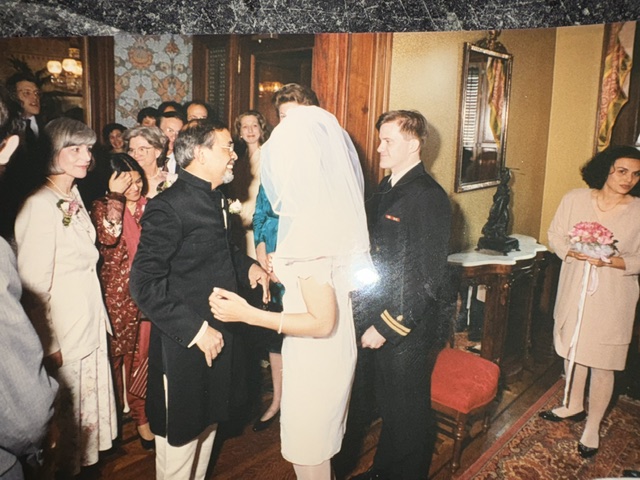
In the late 80’s, when my parents separated, Subir went on his sabbatical year alone back to Berkeley. Yet he was committed to not losing us: he sent tickets for all of us to venture out on our school breaks to visit him. He returned to Minnesota and his work there, got his own place, and began yet another phase of life, always reaching out to invite us, either singly or together, to come over. He took me, while I was a 25-year-old reporter, on a lovely trip to New Delhi, Kolkata and Hyderabad, all of which were areas where he had academic meetings. I took photos and worked on a freelance travel story based on my adventures traveling with him. Just a few years later, he “gave me away” at the wedding where I married Tony.
So, what exactly did Subir Banerjee do within his field? In short, my dad’s research explored how the magnetic properties of rocks, soils, and sediments can reveal the history of the earth and its changing environment. His curiosity took him from lunar samples brought back by the Apollo missions to the landscapes of north-central China and sediments from oceans and lakes around the world. He founded the University’s own Institute of Rock Magnetism, with new opportunities for research that brought many scientists from around the world to Minnesota.
In addition to teaching, my father published more than 200 scientific papers and co-authored a book that served for decades as a standard reference in his field. He was frequently abroad sharing his knowledge and received some of the highest international honors in geophysics and science.
How does an erudite scholar connect with people when they don’t have the education to understand your work? My dad’s strategy was to always try to eat together—and when we were apart, to discuss recipes.
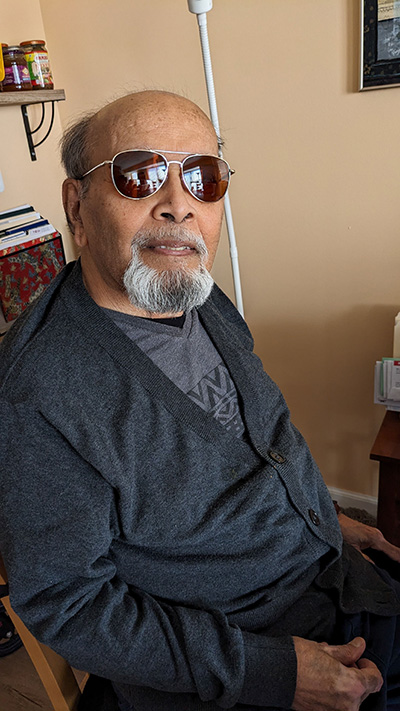
In the decades of separation that stretched from my college years to mature adulthood, my father inevitably asked during each phone conversation about what I was cooking that evening—or had just cooked. He was pleased when I cooked fish, the favorite staple of Bengal; and exhilarated to hear about the fruits and vegetables at Maryland farmers’ markets, available at times Minnesota plants were still frozen underground. He shared equally about his own kitchen adventures and continued to send me occasional recipes written in his exquisite, calligraphic handwriting.
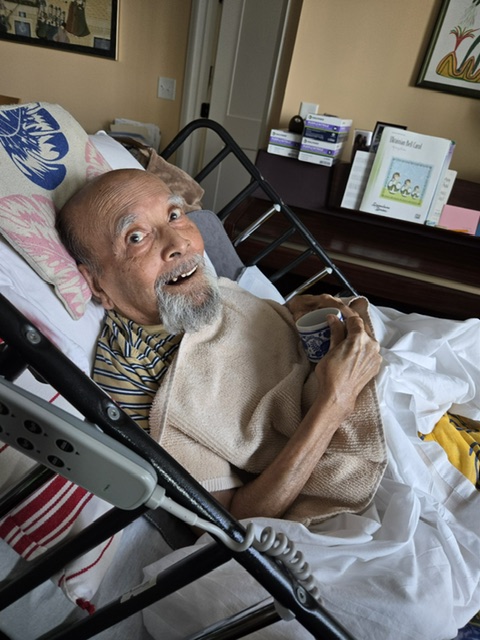
In 1990, my father remarried. His wife Manju, also a retired professor, sent photos of their interesting meals up through the final days before his death. She was at home with him when he passed away from complications from late-stage Parkinson’s disease. My sisters were nearby, and I had recently left for Maryland after an eight-day visit to his bedside in St. Paul.
Parkinson’s was a slow and painful disease that affected him greatly. In the beginning, it turned his energetic walking into an unbalanced, slow gait. Parkinson’s converted his elegant handwriting into a ragged jumble. Later, he suffered intense fatigue and a growing inability to eat and swallow. His decline was a slow, frustrating process—but he never gave up hope that the situation could reverse. He kept active reading, listening to music, and writing. He had just finished a third draft of a children’s book about the history of the compass a few weeks before he died.
As Subir aged, his spirit became more playful, and he loved to tell stories about his encounters narrated in a variety of accents—from Russian to British Received Pronunciation and all the regional Indian varieties. I suspect he secretly studied people’s accents when he was at all those academic conferences and having long meals afterward. His recreations weren’t mockery; rather, the voices were presented to us as a demonstration of his theatrical prowess. He himself spoke a precise sort of English from over a decade of time at Britain’s universities: a scholarly patois that was slightly eased by the many subsequent years in the States. He could have put on a bona-fide American accent if he wanted, but he preferred his very own accent, which was like nobody else’s.
When I was with my father in the days preceding his death, he couldn’t speak. But his eyes opened when he heard my voice. He knew I was there. And as I write this, I ponder: do I have a saved voice mail from him, lurking somewhere in my phone?
I would so like to hear him speak, just once more.